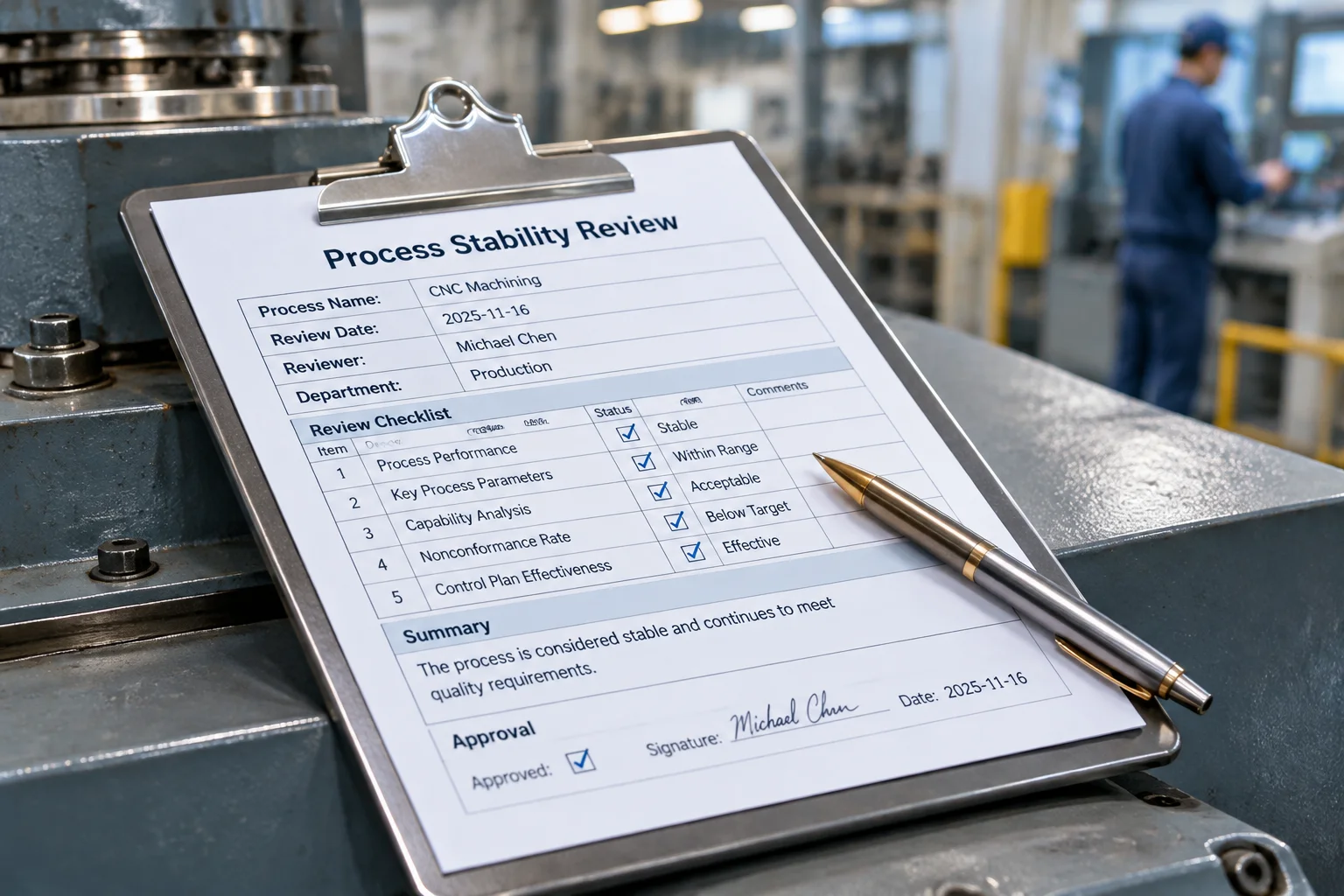
01 The Core Purpose of a Stability Review Note
A process stability review note serves as a structured communication bridge between statistical control charts and real-world operational decision-making. Quality engineers and process analysts frequently encounter data points that fluctuate sharply between shifts. Without a standardized evaluation framework, teams risk misinterpreting natural background variation as operational defects, leading to premature machine adjustments and process tampering.
Rather than treating control charts as evidence of product specification compliance, a stability review note focuses squarely on process predictability over time. It documents the established baseline, verifies whether recent observations reside within upper and lower control limits, and notes any non-random patterns such as runs, shifts, or hugging the center line.
"A control chart demonstrates whether a process is operating in statistical control, not whether the output satisfies customer specifications."
Process Engineering Review
Discuss your statistical variation observations with an atlas specialist.
02 Key Components of an Actionable Review Note
Building a consistent stability review note requires systematic documentation of sampling context, statistical test outputs, and physical system changes. Incorporating these core layers transforms raw numbers into objective operational intelligence:
- Subgrouping & Time Order Context: Document sampling interval, subgroup size, and shift conditions to confirm that rational subgrouping assumptions remain valid.
- Statistical Test Violations: Explicitly log Western Electric or Nelson rules triggered, such as points beyond 3-sigma control limits or runs of 8 consecutive points on one side of the center line.
- Physical Log Cross-Referencing: Match identified chart signals against operator maintenance logs, batch changes, component replacements, or ambient environmental shifts.
03 Distinguishing Signals from Background Variation
One of the greatest hazards in process control is reacting to noise as if it were a special cause. When data points scatter within established control limits, variation is driven by common causes embedded in the system design. Adjusting calibration settings during common-cause variation increases total output variation and degrades product consistency.
When a genuine special-cause signal emerges, the review note records the exact timing and nature of the anomaly. This documented history creates a reliable audit trail, helping engineers trace systemic drift, evaluate tool wear, and prevent recurring operational disturbances across production cycles.
Need Guidance on Process Review Documentation?
Connect with our statistical process engineers to refine your review notes and control chart interpretation standard operating procedures.
Request Methodology ReviewFrequently Asked Questions
Control limits reflect what the process is currently delivering based on its natural variation, while specification limits represent customer requirements. A process can be perfectly stable in a statistical sense yet consistently produce units outside customer specifications if the baseline spread is too wide.
When a signal occurs, log the exact timestamp, subgroup number, rule violated (e.g., Point Beyond Limit, Run of 8), machine settings, operator shifts, and any maintenance events occurring around that time frame.
Review notes should be compiled periodically based on process velocity — typically at the end of every production shift, weekly for batch operations, or immediately whenever a control chart rule violation is flagged by quality software.